


SCHECKs on NXP S32K3: The Missing Layer
SCHECKs provide the missing software layer needed to validate hardware safety mechanisms on NXP S32K3 microcontrollers. As automotive systems become increasingly software-driven and safety-critical, they help ensure reliability, detect hidden faults, and support ISO 26262 compliance through structured verification directly on target hardware.
What are SCHECKs?
SCHECKs are software-based safety tests. They are used to validate hardware safety mechanisms during operation.
In simple terms, they “check the checkers.” For example, they help confirm that built-in protections, such as error detection and correction, behave as expected.
As a result, SCHECKs add an important software layer to functional safety. They help ensure that hardware safety mechanisms continue to work correctly over time. In addition, they support compliance with standards such as ISO 26262.
Why SCHECKs matter?
Microcontrollers such as the NXP S32K3 family include advanced hardware safety mechanisms. However, hardware features alone are not enough.
Without regular validation, it becomes difficult to prove that these mechanisms remain effective during operation. Therefore, SCHECKs provide an extra level of assurance.
They help to:
• Improve overall system reliability
• Detect hidden faults during operation
• Support compliance with functional safety standards
In other words, SCHECKs turn built-in safety features into measurable and auditable evidence.
Why implementation is complex?
Implementing SCHECKs goes beyond traditional embedded software development.
First, engineers need a strong understanding of microcontroller architecture. This includes memory behavior, processor operation, and hardware safety mechanisms.
Then, they must control how memory is accessed and how the software runs. In many cases, verification also needs to be performed directly on target hardware.
For this reason, SCHECK development requires a high level of rigor. Engineers must simulate fault conditions, control system behavior, and verify the results. This helps ensure both functional correctness and compliance with safety requirements.
A smarter approach to Functional Safety
SCHECKs sit at the intersection of hardware, software, and safety engineering.
Because of this, a successful implementation requires a structured end-to-end approach. It must cover configuration, development, testing, and verification.
This approach brings several benefits. It improves consistency across the development lifecycle. It also reduces risk and supports scalable system designs.
At CS Canada, we help simplify SCHECK implementation through a structured engineering approach. Our expertise in safety-critical software, NXP S32K3 platforms, and ISO 26262 allows us to define efficient strategies, set up toolchains and verification processes, and ensure consistency from architecture to validation.
Want to go deeper? Download our white paper to explore the SCHECK development workflow, key technical challenges, and lessons learned from implementation on the NXP S32K3 platform.
CS NEWS
Recent Posts
Categories
LIRE AUSSI
Brochure DO-178C
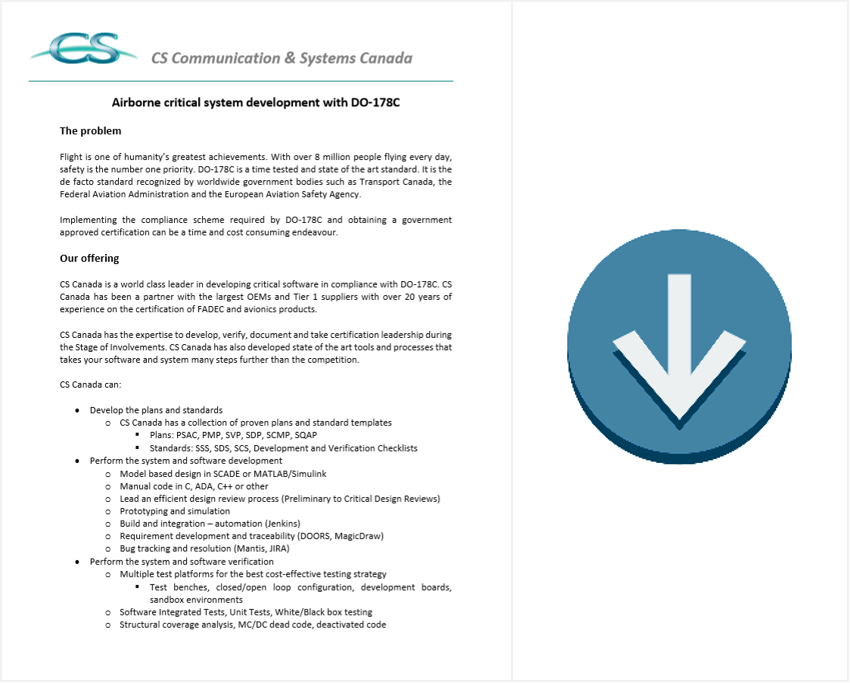
Brochure Aéronautique